

Statement on Commonwealth Games NI Decision to Use the Ulster Banner
Independent Orange Order Welcomes the Common Sense Decision to Stand by the Banner
The Independent Orange Institution warmly welcomes the announcement by Commonwealth Games Northern Ireland (CGNI) that the Ulster Banner will be used to represent Northern Ireland at the forthcoming Commonwealth Games. This decision reflects a long‑standing sporting practice, honours the identity of many athletes and supporters, and provides clarity and continuity at a time when symbolism is increasingly contested.
For decades, Northern Ireland teams across a wide range of sports have competed under the Ulster Banner. Its use in the Commonwealth Games is not new, its not radical, but is rather the continuation of an established tradition. The Committees decision to recognises this respects the heritage of our athletes who have proudly represented Northern Ireland on the world stage.
Sport in general has always brought a welcomed break from division and we would urge all sporting bodies to refrain from making the sports field a battle field for political, ideological or cultural wars.
“Our message is simple” said Grand Master Phil Moffatt “Stick to the sport and let’s make Northern Ireland a winner for us all. We would urge the nationalist community to see beyond their sectarian bias and to lend their support also to our home grown athletes competing on the international stage, they deserve our upmost support”
Politicising Sport Creates Division
He continued “ Recent attempts to challenge or replace the Ulster Banner are, in effect, attempts to politicise sport. such efforts risk deepening division and generating unnecessary controversy. Sport should be a space where athletes of all religious and political persuasions can compete free from political pressure— it cannot become a battleground for symbolic disputes.
The position of Conal Heatley, the Chief Executive of Commonwealth Games Northern Ireland (CGNI), has become untenable. He should be the face of a united focused team who encourage our athletes to success, instead he has encouraged controversy, and moved the focus from our athletes.
If the Ulster Banner were removed, many would feel excluded, alienated, and unrepresented by a team that no longer carried the flag historically associated with Northern Ireland who have competed on the International Stage
Standing Up for the Ulster Men and Women
The Independent Orange Institution believes that local athletes and supporters deserve the same respect and recognition afforded to all other sections of the community.
The Ulster Banner remains the most widely recognised and historically grounded symbol for Northern Ireland’s participation in the Commonwealth Games. We welcome the CGNI’s decision as it ensures continuity, avoids unnecessary division, and respects the identity of those who have carried this flag with pride for generations.
However we believe that Conal Heatley has become part of the problem not the solution.
A Brief History of the Ulster Banner
The Ulster Banner was formally adopted in 1953 for the Government of Northern Ireland and used officially until 1972. However it dates right back to the creation of the state. The Government of Northern Ireland was assigned Armorial Ensigns by His Majesty George V on 2 August 1924. This was the arms which form the basis for the Ulster Banner. The Arms were designed by Major Sir Nevile Wilkinson, K.C.V.O. Ulster King-of-Arms and executed in the Office of Arms, Dublin Castle, by Miss Mabel M’Connell, herald painter to Ulster King-of-Arms. There was of course a design process and the prototype arms may even have been displayed at the Ulster Pavilion in the British Empire Exhibition at Wembley in April 1924.
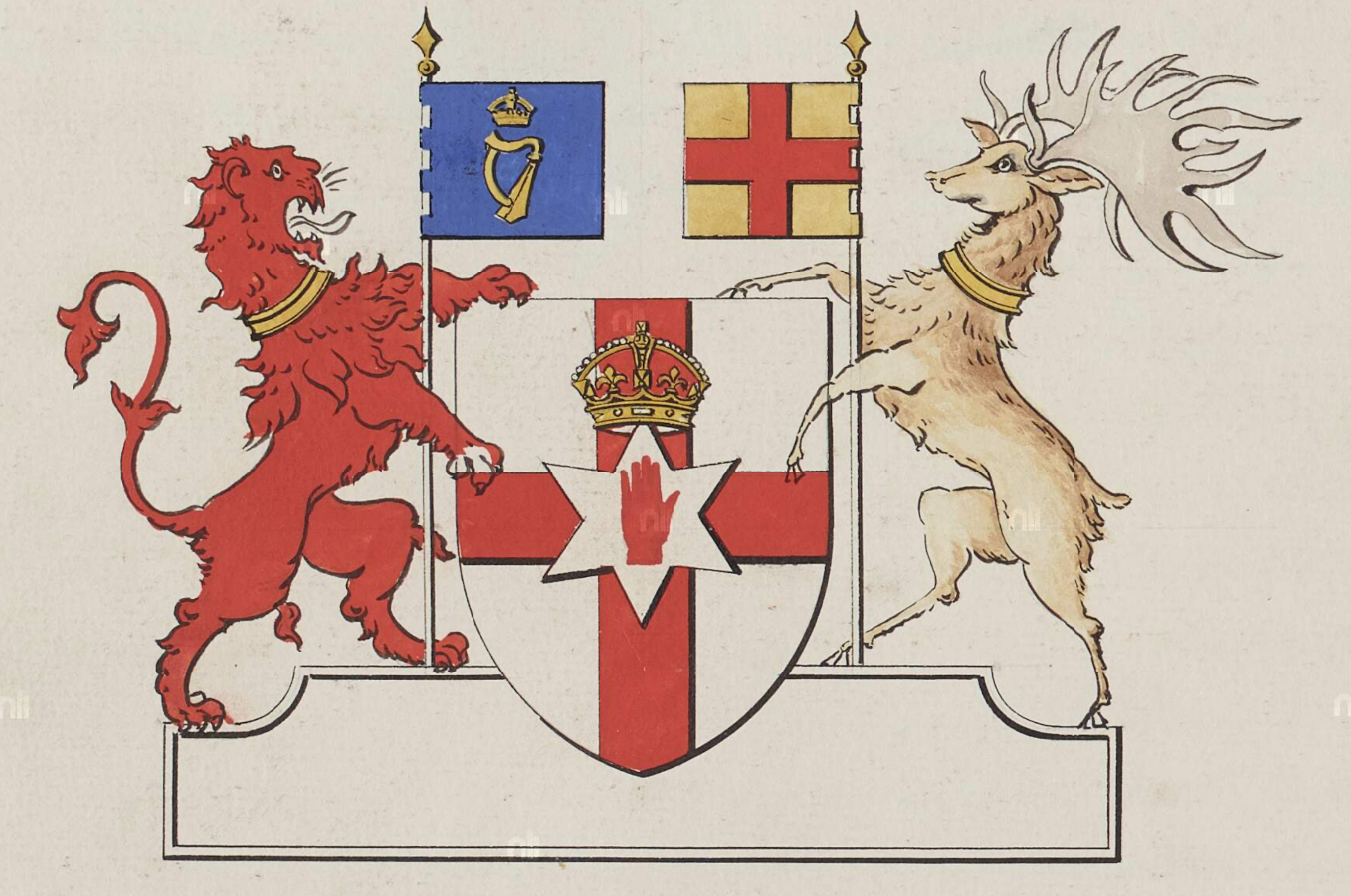 The moment the arms have been granted they can be reproduced in a flag instead of a shield. The first use of the new Arms of Northern Ireland was Royal approval for his representative in Northern Ireland – the Governor to use them as a badge on the Union Flag.
“The Union flag is flown by the Governor of Northern Ireland with a badge upon it of a while shield on a yellow circular field. The shield bears a red Cross St. George, and on the centre of the cross is a white star, six pointed, surmounted by a golden crown. In the white star is a red hand.” Belfast News-Letter – Tuesday 01 September 1925
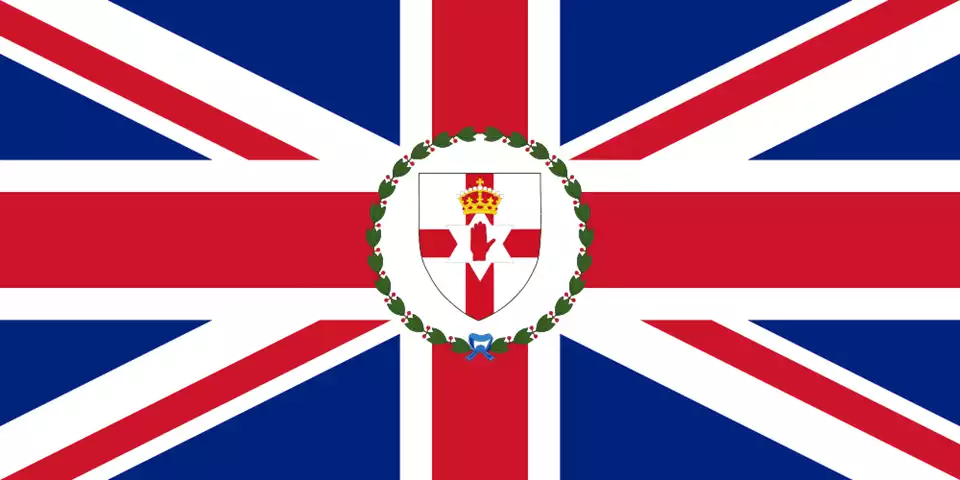 This was the first use of a distinctive Northern Ireland flag. It was listed as in the Errata or update to the British Admiralty book Flags of all Nations the most authoritative source internationally at that time given Britain’s role as the major sea power of the day.
“A new flag, the emblem of the Governor of Northern Ireland, figures in the Errata that the Admiralty have just issued to their book of Flags of all nations. It is a Union Jack, bearing in the centre a laurel wreath encircling a Red Cross shield, which displays the red hand of surmounted a crown.” Aberdeen Press and Journal – Wednesday 29 December 1926
It continued to be used through the 1930s as the official emblem or in modern parlance the logo of Northern Ireland for example on posters of the Empire Marketing Board.
The official flag of Northern Ireland was and remained the Union flag with Ireland represented by the cross or saltier of St Patrick despite the secession of the southern potion of the island. Successive Unionist Governments preferred the formal display of the Union flag as that best illustrated and reinforced Northern Ireland’s position within the United Kingdom and it close ties to the mainland.
Such was the comfort and convenience of using the Union Flag there was thought little need and no political constitutional or legal basis for the development of a distinct Northern Ireland flag. There were unofficial designs and displays such as a Blue Ensign with the arms of Northern Ireland such as was common practice for the rest of the Empire. One feature is consistent in these designs and this is the arms of Northern Ireland. However arms can only be granted to and used by a person or entity it cannot be granted to an area, or territory.
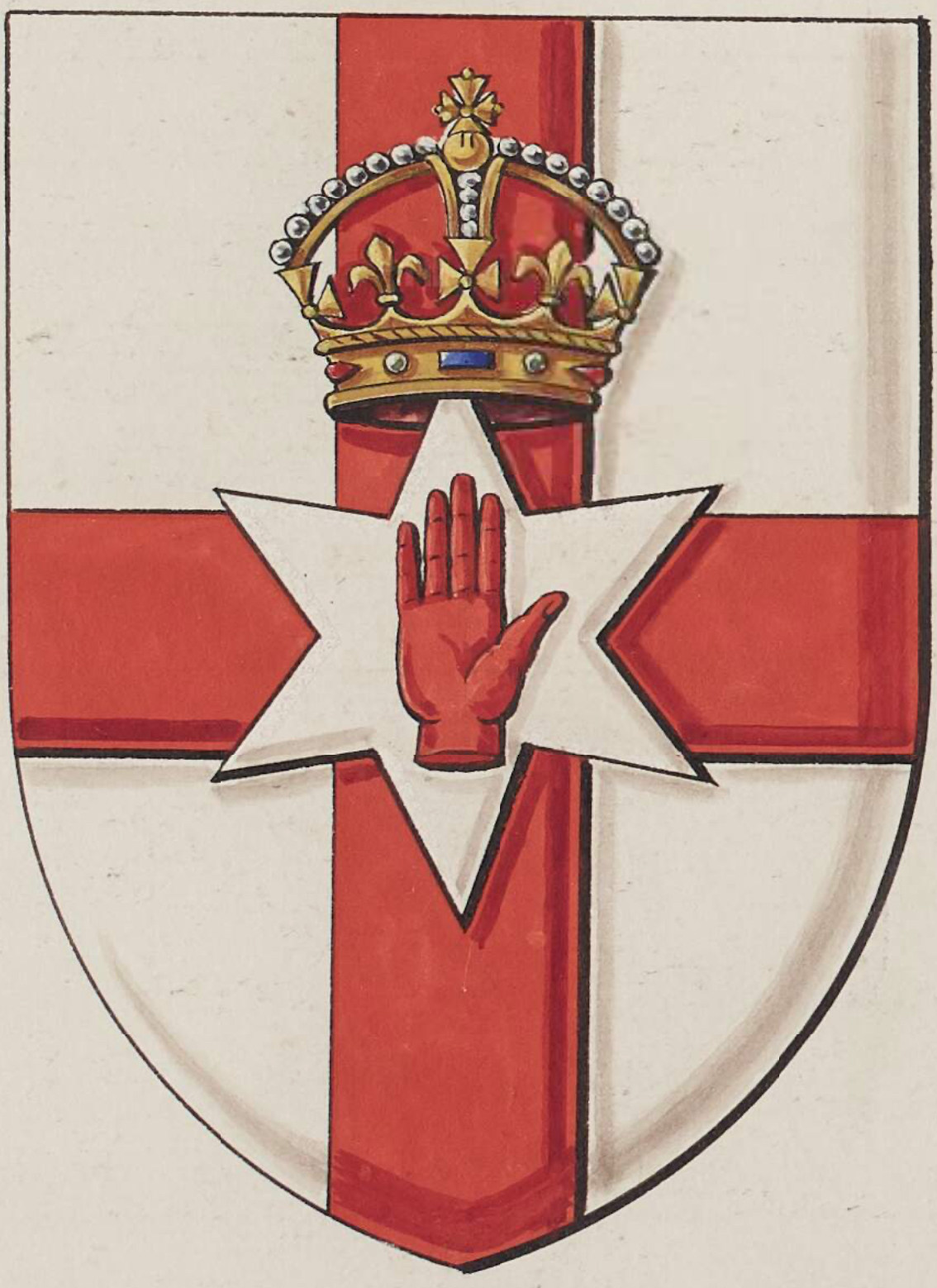 The issue of a Northern Ireland flag and its adoption did not first arise in 1953 as many commentators allege. What happened was the the Royal Coronation focused attention and minds on what flag or emblem was specially distinctive of Northern Ireland. The matter was settled in a Parliamentary answer by the redoubtable Prime Minister Basil Brooke in response to Mr. N. Minford, who asked the question on behalf of Dr. Rodgers (U.. Pottinger).
“Viscount Brookeborough replied that the Union Jack was, of course, the national flag of Northern Ireland. There had been widespread requests for an additional emblem which, while not supplanting the Union Jack, would be specially distinctive of Northern Ireland. The banner referred to simply reproduced in flag instead of shield form the Arms of the Government of Northern Ireland which where designed Ulster King of Arms and were granted by Royal Warrant in 1924 with an additional grant Supporters made by Royal Warrant in 1925.” Ballymena Observer – Friday 20 November 1953
The Belfast Newsletter happily informed the country in an article entitled ‘DECORATIONS The Ulster Government’s banner’ that loyal citizens could fly the Ulster Flag.
“Many Loyalists engaged in decorating their houses for the Coronation have inquired if there is a Northern Ireland flag. The position is that the Union Jack is the only flag that has been officially authorised and flown. In view, however, of the desire of a number of people to fly a flag distinctive of Northern Ireland the Government has no objection to the flying, for this purpose, of the Government banner. This would be a white flag, carrying the Cross of St. George (in red), and in the centre of the cross a white six-pointed star carrying the Red Hand of Ulster, the star being surmounted by the Imperial Crown.” Belfast News-Letter – Saturday 30 May 1953
The official and longstanding status of the Ulster Banner was champed by CAPT. H. Malcolm McKee MC a war hero who served as a district inspector in the Royal Irish Constabulary and qualified as a solicitor. When the ‘Ulster Banner’ reproduced following the pattern approved by Lord Brookeborough in 1953 to coincide with the visit of the newly crowned Queen Elizabeth II, many expressed surprise at its existence. There was also question around the origin of the red cross and the flag design generally. Cpt MKee a renowned expert in heraldry and history sprung to its defence illustrating its history and pedigree in the letters columns of local newspapers. He stated authoritatively that
“Northern Ireland Government has Arms, and these Arms on a banner are our flag as well as the Government’s… It nonsense saying the Northern Ireland banner never was seen. I have seen it dozens times, and also the Blue Ensign with the Northern Ireland Arms the fly.” Northern Whig – Friday 29 May 1953
His case was clear – the Royal grant of arms entitled Northern Ireland to a flag from August 1924. “I was delighted to realise Northern Ireland was entitled to a Flag of its own—for every individual or corporate body is entitled to display them [arms] on a flag, e.g. Canada and Australia. I wrote to Sir Gerald Wollaston, Norroy and Ulster King of Arms, who for fifteen years was Garter. As well as Norroy and Ulster he was the Earl Marshal’s secretary and Inspector of Regimental Colours. I stated the case for a Flag for Northern Ireland. He admitted the rightness of the claim though he pointed out that the flag would be novel and unique in the Kingdom!” Northern Whig – Tuesday 26 May 1953.
H. Malcolm McKee did not in his words lay claim to conceiving the flag merely delivering it. His research and advocacy lay behind the recognition and role of the flag in Coronation year and beyond. When Stormont was prorogued in 1972 against the wishes of the majority of the people of Northern Ireland many claim that the arms of the Government and the right to display them on a flag equally disappeared. However this is not simply the case. Firstly while the arms and flag were attached to the Government of Northern Ireland and that particular body as was envisaged in the Government of Ireland Act 1920 ceased to exist in that particular form there has remained a Northern Ireland and it has in various forms had governments from 1972 until the present.
While the Union flag was, remained and is today our official flag and its display is guaranteed and regulated by legislation the same need and basis remains for the Ulster Banner. Its existence has always been de facto and that remains, since no government of form of government for Northern Ireland has ever replaced it or take to itself an alternative Armorial Ensign. No Royal revocation or regrant is evident. Therefore while Northern Ireland exists, while it has a government of some sort and that government does not request and is not granted and assigned a new Armorial Ensign then the status of the Ulster Banner remains u changed. The words of our former Prime Minister Lord Brookeborough remain the authority on the matter “ the Union Jack is, of course, the national flag of Northern Ireland. There had been widespread requests for an additional emblem which, while not supplanting the Union Jack, would be specially distinctive of Northern Ireland.”
That is the basis on which the Ulster Flag has always been displayed and in the realm of sport and representation of Northern Ireland it is most needed. Our use of the national flag the Union flag is difficult in terms of sporting events and it is necessary to have something particular to Northern Ireland. The Ulster Banner is our recognised sporting flag for Northern Ireland in numerous international competitions, including the Commonwealth Games.
Its design incorporates:
• The historic Red Hand of Ulster
• The six‑pointed star representing the six counties
• The Crown symbolising constitutional loyalty
Over time, the Ulster Banner has become a widely understood emblem of Northern Ireland’s sporting identity. It is used not as a political statement but as a practical and recognisable symbol for teams competing internationally.
